August 7, 2026
Understanding the Agricultural Impacts of Wildfire Smoke
Volume 20, Issue 8
August 2026
Wildfire smoke darkened skies across the Northeast for at least three consecutive days this July. Orange clouds and dusky afternoons prompted apocalyptic comparisons as evidence of fires raging thousands of miles away in Ontario, Canada and northern Minnesota billowed as far as New Jersey and Southern New England. While the duration and impact of wildfires have historically been concentrated in the Western United States, the issue is becoming a more frequent concern on the east coast. What impact does sustained wildfire smoke have on agriculture in our region?

NOAA Hazard Mapping System Fire and Smoke Product. July 14, July 15, July 16, 2026 with lingering air quality impacts until July 19, 2026.
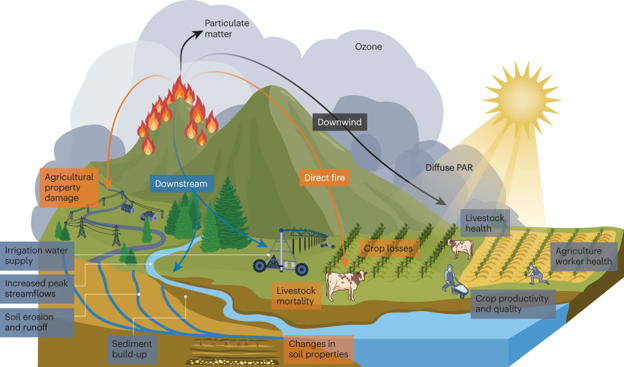
The agricultural impacts of wildfires themselves are numerous and serious. These include damage to agricultural lands, death and stress caused to livestock, impacts to water quality and increases in sediment build up in the water table, increased erosion and runoff, and other concerns.1 While the frequency and magnitude of wildfires are increasing across the United States, including in the Northeast, wildfire smoke events are also on the rise, with one study from across the U.S. finding that wildfire smoke now affects approximately 20% of growing season days.2 Samantha Borisoff, a climatologist at the Northeast Regional Climate Center, notes that the duration of this incident was prompted by “a heat dome parked over the central U.S., causing prevailing northwesterly winds to transport the dense smoke into the Northeast.”
Wildfire smoke may be a byproduct with real, direct impacts on agricultural lands. Dr. Alistair Hayden, an Assistant Professor of Practice at Cornell University’s College of Veterinary Medicine, studies wildfires and their impacts. “There are three buckets I’d be concerned about,” Dr. Hayden said regarding the impact of wildfire smoke on agricultural production. “Worker health, livestock health and plant impacts.”
NOAA Hazard Mapping System Fire and Smoke Product. July 14, July 15, July 16, 2026 with lingering air quality impacts until July 19, 2026.
Crop Impact
According to a recent article from Penn State Extension, wildfire smoke can lead “to both beneficial and detrimental effects on crop growth;” the net impact of smoke exposure varies depending on the crop and specific environmental conditions, making it difficult to predict.3
Particulate matter changes the characteristics and availability of light reaching plants.4 While wildfire smoke can create diffuse light conditions that benefit lower leaves of corn and soy plants, this rarely offsets reductions in the amount of sunlight able to reach crop canopies as a result of smoke incidents.5 C4 photosynthesizing plants, like corn, sorghum and other warm-season crops, are especially sensitive to the reduction in solar radiation and most susceptible during the reproductive and grain fill growth stages.6 C3 plants like soybean and wheat may be less impacted as long as the duration of reduced radiation is short.7 The effect can be difficult to predict. For example, despite measurable reductions in sunlight due to wildfire smoke in Ohio in 2023, the state achieved record corn, soybean and wheat production.8
Wildfire smoke contains oxidizing gases, such as ozone (O3), which can hinder photosynthesis and lead to disease and reductions in yields. The estimated annual financial cost of these productivity declines may be $1 billion for perennial crops in California alone. However, East Coast farms far from origin fires may not see these effects – the distance between Midwest and Canadian fires from the Northeast may be enough to make crop injury negligible.
Grapes are especially sensitive to wildfire smoke and suffer from a specific condition called “smoke taint” in the event of hazard events.9 Grapes can absorb chemicals from the smoke which can alter, and sometimes ruin, the taste and smell of resulting wines.10 This result can be hard to predict, leading to expending time and resources before the effect of the smoke taint becomes apparent. The National Grape Research Alliance has published guidance and resources specific to this issue to support the grape and wine industry.11
Timing may be the most significant factor, with grain crops tolerating smoke well during early vegetative phases and at highest risk during the grain fill period.12 Grapes may respond similarly, with less impact of smoke taint reported during smoke hazard incidents earlier in the season before the fruit develops.
Impact on livestock
Livestock are also impacted by wildfire smoke events, which can cause stress, irritate eyes and respiratory tracts, and induce nervous or aggressive behavioral responses.13 Recent studies in Colorado and Idaho found that increased exposure to particulate matter was significantly associated with decreased milk yield.14 A recent review also found reductions in meat quality in some beef cattle.15
However, limited research in this area means the precise impacts of limited exposure windows, like we saw this July, are unknown but may cause little to no effect. Robert Lynch, Doctor of Veterinary Medicine and Dairy Herd Health and Management Specialist with Cornell PRO-DAIRY, thinks the impact of this specific smoke event may have been limited. “Our cows here in New York have been pretty lucky,” he said.
“I agree that prolonged exposure to particulate matter can cause respiratory disease and distress. It’s hard to separate the smoke exposure from other issues happening at the same time. But I was surprised how the cows just went about their business as usual.”
Impact on workers
Wildfire smoke has measurable impacts on human health and can cause respiratory irritation and trigger underlying health conditions like asthma among agricultural workers.16 Workplace policies requiring increased awareness of and response to wildfire smoke are gaining attention nationally. Smoke from Canadian and regional fires prompted headlines across the Northeast in the summer of 2023, prompting the New York State Department of Labor to publish comprehensive guidance for employers.17 The economic effect of reduced working hours, training and administration related to smoke management have not yet been quantified for the Northeast.
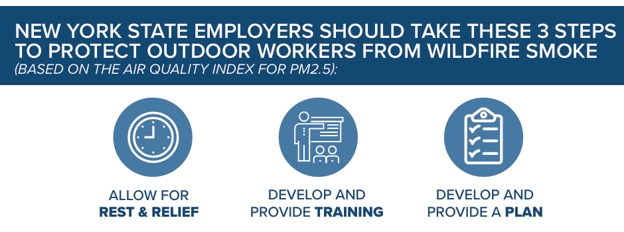
Guidance from the New York State Department of Labor, 2024.
The known and unknown
Despite the growing body of research in this area, much more is needed to fully understand the issue. “This is a question everyone has, for whatever sector they’re in,” Dr. Hayden said. “There is not a huge amount of work on agriculture-specific impacts, and the work there is tends to be in the West. A lot of this can be applicable, but there can be differences based on proximity to smoke.”
To determine the specific impact of a smoke hazard event on crops, animals and workers, a variety of data including smoke age, thickness, altitude, and canopy structure would be needed.18
While the complete impact of wildfire smoke in the region remains relatively unknown, some immediate influences are clear. In the days following this July’s Canadian smoke incident, the Trump administration threatened tariffs against Canada in direct response.19 The administration has since announced plans to impose a 50% tariff on a variety of Canadian imports, including agricultural products.
Beyond political implications, the threat of drought in the region has continued throughout the summer, prompting fears of localized wildfire events and their immediate threats of loss to land and livestock.20
“In 2023, people felt surprised by the extent and magnitude of the wildfire smoke. And now we’ve had three smokey summers out of the last four,” Dr. Hayden notes. “So, at this point, it highlights to me that this is probably not a one off, it’s something all aspects of our community should be planning for, including our agricultural community.”
He advises farmers to reach out to their local Extension agent to report any unusual activity that could be connected to this event. “This research could be used as a case study to help others,” he says.
Samantha Borisoff, the climatologist, states that “although wildfires are a natural feature of Canada’s boreal forests, warming temperatures are fueling a longer fire season and creating favorable conditions for more intense and destructive wildfires.” Signs are pointing to increased number and duration of these types of smoke hazard incidents, and we will be keeping our eyes open for more information on their effects as the data develops.
Sources
19Chemnick, Jean, Davidson, Amelia, Harvey, Chelsea. Trump threatens Canada over wildfire smoke choking U.S. cities. Politico. 17 July 2026. https://www.politico.com/news/2026/07/17/canada-wildfires-smoke-trump-01002976.
2Corwin, K., Corr, C. A., Burkhardt, J., & Fischer, E. V. Smoke-Driven Changes in Photosynthetically Active Radiation During the U.S. Agricultural Growing Season. Journal of Geophysical Research: Atmospheres, 127(23). 2022. e2022JD037446.
8, 12, 13, 14Drohan, Joy. Wildfire smoke and crop development – it’s complicated. Crop Soils: Volume 59, Issue 7. 17 June 2026. https://www.sciencesocieties.org/publications/crops-soils/2026/july/wildfire-smoke-crop-development.
17P197: Employer Guidance: Protecting Outdoor Workers from Extreme Weather: Wildfire Smoke Hazards. New York State Department of Labor. September 2024. https://dol.ny.gov/system/files/documents/2024/10/wildfire-smoke-guidance-p197.pdf.
20Hazard Mapping System Fire and Smoke Product. NOAA OSPO. 14 – 16 July 2026. https://www.ospo.noaa.gov/products/land/hms.html#maps.
19Hunnicutt, Trevor, Lang, Hannah. Trump says he told Carney that Canada must get wildfires under control. Reuters. 20 July 2026. https://www.reuters.com/business/environment/trump-says-he-told-carney-that-canada-must-get-wildfires-under-control-2026-07-20/.
4, 12, 13, 14, 16, 18Kabeshita, L., Sloat, L.L., Fischer, E.V., Kampf, S., Magzamen, S., Schultz, C., Wilkins, M.J., Kinnebrew, E., Mueller, N.D. Pathways framework identifies wildfire impacts on agriculture. Nat Food 4, 664–672. 7 August 2023. https://doi.org/10.1038/s43016-023-00803-z.
10Madhusoodanan, Jyoti. Science and Culture: Wildfires pose a burning problem for wines and winemakers. 18 August 2021. https://doi.org/10.1073/pnas.2113327118.
9, 16Mercier, Stephanie. The Impact of Wildfires on the Agricultural Sector. Farm Journal: AgWeb. 9 January 2026. https://www.agweb.com/news/policy/impact-wildfires-agricultural-sector.
15Pace, Alexandra, Rezamand, Pedram, and Skibiel, Amy L. Invited Review: The impact of wildfires, air pollution, and air quality on the health and production of dairy cattle. Journal of Dairy Science. 2026. https://doi.org/10.3168/jds.2025-27023.
3Roth, Greg; Person, Arthur; Imhoff, Kyle. Wildfire Smoke: Growing Crops Through the Haze. Penn State Extension. 21 July 2026. https://extension.psu.edu/wildfire-smoke-growing-crops-through-the-haze.
11Rumbaugh, Arran. Safeguarding US Vines and Wines from Wildfire Smoke. National Grape Research Alliance. 2025. https://graperesearch.org/2025/07/29/safeguarding-us-vines-and-wines-from-wildfire-smoke/.
5, 6, 7What Impact Does Wildfire Smoke Have on Corn and Soybean Crops? Bayer Crop Science. 21 July 2026. https://www.cropscience.bayer.us/articles/bayer/wildfire-smoke-on-crops.
Editor: Chris Laughton
Contributors: Kyle Karnuta, Knowledge Exchange Specialist, Farm Credit East
View previous editions of the KEP
Farm Credit East Disclaimer: The information provided in this communication/newsletter is not intended to be investment, tax, or legal advice and should not be relied upon by recipients for such purposes. Farm Credit East does not make any representation or warranty regarding the content, and disclaims any responsibility for the information, materials, third-party opinions, and data included in this report. In no event will Farm Credit East be liable for any decision made or actions taken by any person or persons relying on the information contained in this report.
Tags: outlook, farm safety, labor, livestock
- Share this post on


