November 3, 2026
More Challenges Ahead in Grape and Wine Markets
Volume 20, Issue 11
November 2026
Contributed by Andrew Adams, Senior Editor with WineBusiness Monthly
There was little relief from the many challenges facing U.S. wineries and grape growers in the past year, and 2027 will likely be as difficult if not more so given waning consumption and the increased cost of doing business.
Several years of declining market volume and decreased wine consumption — especially among wine’s best customers — make it clear that the U.S. wine market is undergoing a historic contraction. There will be no recovery to the market we had before the COVID-19 pandemic, let alone the market that fueled the growth of thousands of wineries across the United States in past decades.
No region is fully immune from the decline in U.S. wine consumption. The 2026 California winegrape harvest is likely to be the smallest in decades, a direct result of Americans drinking significantly less wine. Structural challenges have been compounded by new ones, such as the near-total collapse of the export market in Canada because of a trade dispute that has also contributed to a decline in tourism. Car crossings from the Montreal region at Champlain, N.Y., ran roughly 30% below 2024 levels for much of 2025, the North Country Chamber of Commerce reported.
Further declines toward stability
Without a rebound, future growth depends on the market achieving stability. As supply falls into balance, shoring up demand would provide that stability by 2028. A stable, albeit smaller, market would then be positioned for more sustainable growth, and the producers that maintain or increase their share will be poised for growth in the 2030s.
The wine market has grown slightly in value over the past year, but only due to price inflation, while volume declined. In the 12 months through September 2026, total U.S. wine market value came to $115 billion, 2% more than during the same period last year, according to the market research group bw166. Total volume, however, declined a further 7% to 340 million 9L (12x750ml) cases. Domestic table wine value grew by nearly 7% to $78 billion as volume declined 6% to 193 million cases. Two price tiers help explain the disconnect between market value and volume. Wine in 750ml bottles priced between $8 and $11 declined 9% by value and 8% by volume in the 52 weeks ended Sept. 5, according to NIQ, while wines priced between $20 and $25 slipped by less than 1% by value and volume.
The $20 to $25 price tier, however, accounted for less than 3% of the total sales volume tracked by NIQ. Until sales of lower-priced wines stabilize, market volume will continue to shrink.
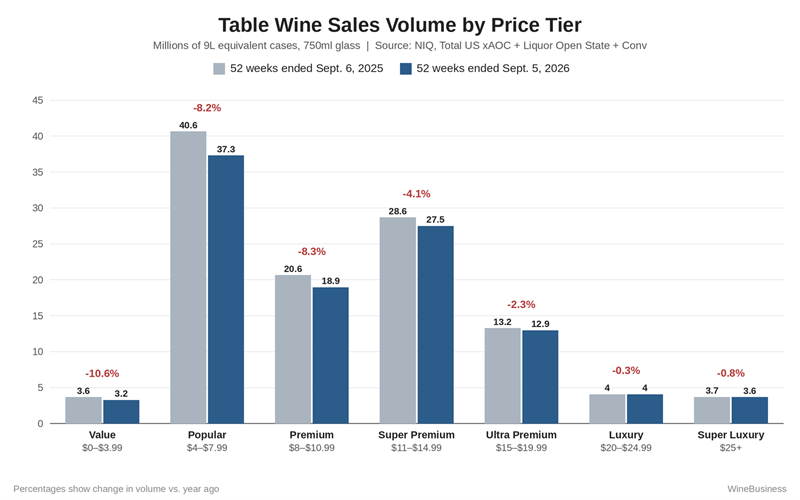
Off-premise table wine sales volume declined across all NIQ price tiers over the past year, but the declines narrowed as prices rose, from 11% at the least expensive tier to less than 1% for wines priced $20 and up.
Data from bw166 and NIQ indicate the on-premise sector is performing better than retail. On-premise sales of domestic table wines gained nearly 9% in total value to more than $27 billion, according to bw166. NIQ reported on-premise wine sales fell 2.6% to $13.5 billion in the year ended Aug. 8, versus a 5% drop for off-premise table wine.
Higher prices, fewer wineries in the Northeast
In this period of sales contraction, the reputation of American wine has paradoxically never been better. Wineries across the Northeast have regained the quality and perception of quality for their wines that were first lost by Prohibition and overshadowed by the revitalization of the West Coast wine industry that began in the mid-20th century. Aromatic white wines, lighter-bodied reds such as Cabernet Franc and sparkling wine are some of the few areas of growth in the wine market, and Northeastern wineries are well positioned to capitalize on this. Riesling and Cabernet Franc are each made by more than a third of the region’s wineries, according to the bw166 winery database. Riesling direct-to-consumer (DTC) shipments from wineries east of the Rockies grew 6% by volume and 12% by value in 2025.
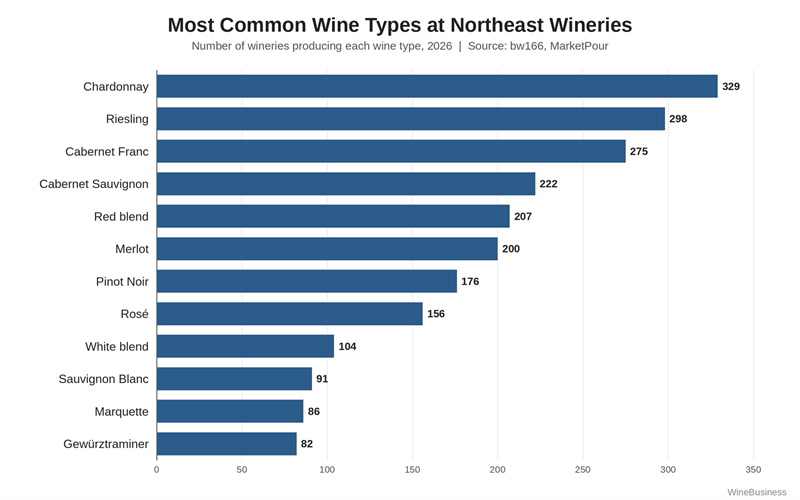
Red and white blends and rosé are each made by more Northeast wineries than Sauvignon Blanc, and the hybrid Marquette ranks 11th.
Those wineries are also charging more for their wines. In 2026, 26% of Northeast wineries with a listed price had an average bottle price of $25 or more, up from 14% in 2020, while the share averaging less than $15 fell from 16% to 10%, according to the bw166 winery database.
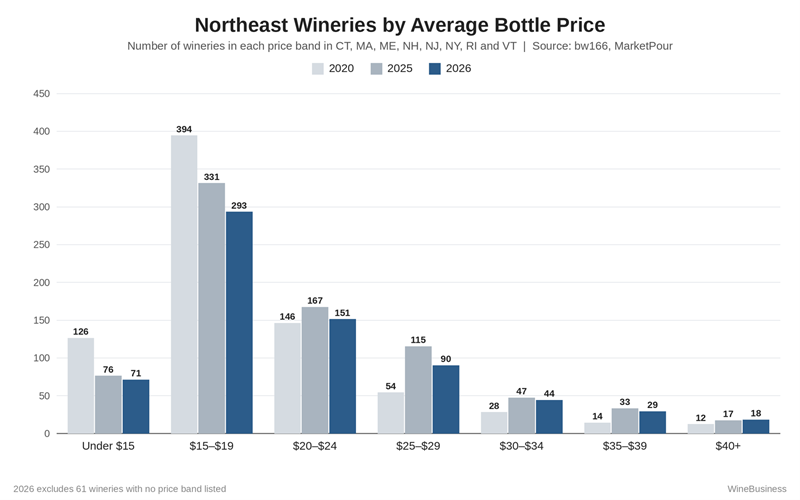
The number of Northeast wineries averaging $40 or more a bottle rose to 18 in 2026 from 12 in 2020, while those averaging less than $15 fell 44%.
A year ago, the number of wineries in the East appeared likely to hold steady unless rising costs, declining demand and competitive pressure intensified. They did. The eight Northeast states had 757 wineries in 2026, 4% fewer than in 2025, as New York lost 20 wineries and only Connecticut and New Jersey added any.
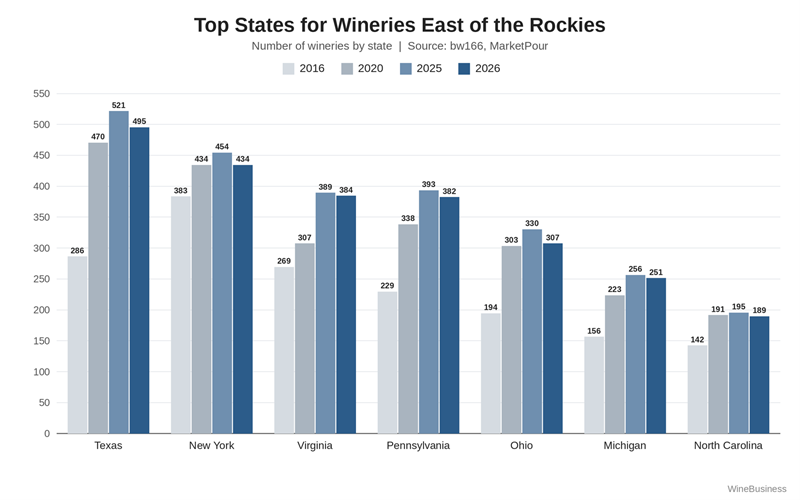
All seven leading winery states east of the Rockies lost wineries in 2026, but each remains above its 2016 count. Texas, Pennsylvania and Michigan are up 60% or more.
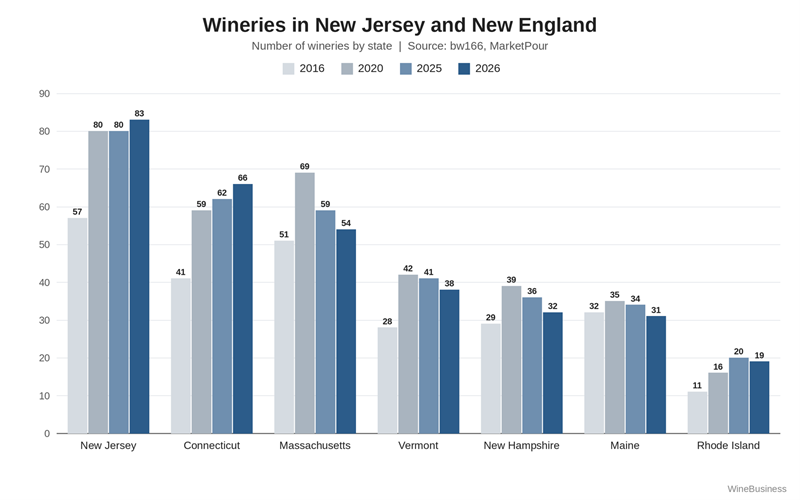
New Jersey and Connecticut were the only Northeast states to add wineries in 2026, while Massachusetts has lost 15 since 2020.
Increased market pressure arrived during a growing season marked in parts of the East by one of the most devastating freezes in years. A warm spring pushed vines weeks ahead of an April 20-21 freeze, and USDA issued emergency crop-insurance procedures for 13 states, including four in the Northeast. The median New Jersey grower estimated 75% vineyard damage in a Garden State Wine Growers Association survey. Some Finger Lakes growers expected yield losses of 15% to 30%, while Long Island reported average yields.
Doing more to create a reason for the sale
In states where wineries can self-distribute, it could be worth building a restaurant program of bottle and by-the-glass sales. Even if such a program breaks even, the brand exposure could entice visitors to the tasting room, leading to new club members and higher-margin direct sales.
That is, if one’s tasting room staff can make the sale, which has become much harder. According to national DTC shipment data from WineBusiness Analytics and Sovos ShipCompliant, total shipments year to date through June were down 15% by volume and 4% by value. The much smaller value decline is because wines priced more than $100 have outperformed the rest of the channel. Wineries east of the Rockies fared worse: shipments fell 11% by value to $81.3 million and 17% by volume to 254,795 cases. Average bottle price rose 6% to $26.58, less than half the national average. That follows a year when their shipments fell 16% to $188 million in 2025 after leading all regions in 2024.
DTC shipment value from wineries east of the Rockies fell 16% to $188 million in 2025, much steeper than the channel’s 6% decline, and the region’s share of the channel slipped from 6% in 2019 to about 5%.
Those figures capture only part of the business for Eastern wineries, who sell most of their wine to visitors who take it home. Wineries east of the Rockies that responded to the 2026 WineBusiness Tasting Room Survey said about 94% of tasting room sales by value were carried out rather than shipped, and club members picked up a median 90% of their wine. Virginia and New York wineries account for more than half of the survey’s Eastern respondents.
By that measure, the region held up better than shipments suggest. The median winery’s tasting room visits were flat in 2025 at about 10,500, and average club membership grew 5% as new sign-ups outpaced cancellations, compared with 1% growth for all respondents. Slightly more Eastern wineries grew DTC revenue last year (45%) than saw it fall (43%), and 95% have not cut tasting fees.
The survey also points to room for improvement. Eastern wineries charge a median $16 for a basic tasting, compared with $25 for all respondents, and the median tasting room purchase is $60 versus $90. Clubs account for about a fifth of Eastern DTC sales, roughly half the overall share, and the median winery adds just 5% of visitors to its mailing list, compared with 20% overall. Capturing more visitor information is an inexpensive way to build the customer base these wineries will need to maintain market share.
Respondents considered the economy (69%), weak interest from younger drinkers (44%) and a lack of tourism (42%) to be their biggest obstacles in 2026. Two-thirds said social media and digital marketing have been the most effective way to reach new and younger consumers.
Top-performing wineries in the DTC channel credit hospitality staff that can offer whatever type of experience visitors may be seeking, ranging from the traditional tasting flight to simply a place for friends to meet over a glass of wine. DTC managers are also using new technology to run highly segmented marketing campaigns via email, text and phone calls.
It is no longer a matter of just making good wine with the expectation that enthusiasts will find you. Wineries need to actively market their experience and club as worth the investment in time and money by consumers. That marketing must also account for Artificial Intelligence, as more consumers ask chatbots where to visit and what to buy.
There is no single reason for the decline in wine consumption; causes range from broad societal changes in how people spend their free time to more specific factors such as the popularity of GLP-1 drugs that reduce the desire to drink. The industry has been slow to react because blaming the change solely on the aging Baby Boomer generation lulled it into false confidence that younger consumers would eventually find wine. They are, but at a rate that is not going to replace the Boomer cohort while myriad other experiences and products compete with wine for their limited free time and discretionary spending.
In the near future, the U.S. wine market will be smaller and supported by fewer wineries, a shift already underway in the Northeast. The wineries that will be thriving then are the ones that ask the hard questions now and invest in the technology and staff to reach that more stable market.
Editor: Chris Laughton, Director of Knowledge Exchange
Contributors: Andrew Adams, WineBusiness Monthly
Andrew Adams is a senior editor with WineBusiness Monthly and produces and coordinates the publication’s editorial coverage of the industry in the eastern United States. Adams is also the editor of the weekly newsletter Deals, Data and Insights that features regular market analysis, data and original reporting on the entire industry.
View previous editions of the KEP
Farm Credit East Disclaimer: The information provided in this communication/newsletter is not intended to be investment, tax, or legal advice and should not be relied upon by recipients for such purposes. Farm Credit East does not make any representation or warranty regarding the content, and disclaims any responsibility for the information, materials, third-party opinions, and data included in this report. In no event will Farm Credit East be liable for any decision made or actions taken by any person or persons relying on the information contained in this report.
2027 Wine and Grape Outlook Webinar
Thursday, November 12, 2026
12:00 PM - 1:00 PM EST
Join Farm Credit East and Horizon Farm Credit as they host Andrew Adams, from WineBusiness Monthly, covering what's ahead for the wine and grape industry in 2027.
Tags: outlook, ag retail, fruit, wine
- Share this post on


