October 5, 2026
Farm Labor Policy in Transition: Updates on SAWA, H-2A and AEWR
Volume 20, Issue 10
October 2026
Finding and retaining workers remains one of the biggest challenges facing agriculture today. Farm Credit East regularly hears from customers across the Northeast who struggle to secure the workforce needed to operate and grow their businesses. This issue is not unique to the Northeast and can be felt across the nation, regardless of the type of farming operation. This article provides an overview of the current H-2A program and proposed federal legislation that would introduce significant changes to the program meant to address farmer needs.
Understanding H-2A and Why Farmers Say the Current Program Falls Short
The H-2A visa program is the nation's primary legal pathway for farmers to hire temporary, seasonal foreign workers. The program was established by the Immigration Reform and Control Act of 1986 and allows foreign nationals to work in U.S. agriculture on a temporary basis. H-2A is a nonimmigrant visa program and does not provide a pathway to citizenship. To hire H-2A workers, employers must demonstrate that they attempted to hire domestic workers and that hiring foreign workers will not adversely affect the wages and working conditions of U.S. workers. Employers must also meet housing, transportation and wage requirements regulated by the Department of Labor and state agencies.
While the H-2A program provides a legal source of labor, many farm operators argue that it has not kept pace with the realities of modern agriculture.
The most significant limitation is that the program was designed primarily for seasonal or temporary labor needs. This works for fruit, vegetable and nursery operations that have defined planting and harvest seasons. However, many agricultural sectors (i.e. dairy, livestock and certain specialty crops) require labor year-round.
As a result, many year-round agricultural employers have historically been unable to access the H-2A program even when they face the same labor shortages as seasonal operations. Farmers have also criticized the program for being overly complex with extensive paperwork requirements, lengthy processing times and unpredictable labor costs. Farm groups contend that these administrative burdens make it difficult to secure workers when they are needed most.
Securing Agriculture’s Workforce Act (SAWA)
In response to these challenges, House Agriculture Committee Chair Glenn “GT” Thompson (PA-15) introduced H.R. 9535, the Securing Agriculture’s Workforce Act of 2026 (SAWA), legislation aimed at modernizing and improving the H-2A program. According to Chairman Thompson, the program is "woefully outdated" and no longer reflects the realities of today's agricultural workforce needs.
SAWA would make several significant changes to the H-2A program. Among its key provisions, the bill would:
- Expand access to H-2A labor for certain year-round agricultural operations.
- Modernize labor certification requirements and streamline the application process.
- Allow employers greater flexibility by permitting staggered worker arrival and departure dates.
- Improve coordination among government agencies through a national online platform.
- Create clear housing standards and compliance requirements.
- Strengthen worker protections, including wage safeguards and heat illness prevention requirements.
- Reform wage calculations to provide greater predictability for employers while maintaining worker protections.
It is also important to understand what this bill does not do. While the focus is on expanding access to the H-2A program, the bill does not create a pathway for U.S. citizenship. H-2A workers would continue to participate in the program as nonimmigrant workers under existing immigration law.
Reasons for SAWA: Labor Costs and Availability Trends
Supporters of SAWA cite a shrinking pool of domestic agricultural workforce and rising input costs as key reasons for the legislation. According to the USDA’s Economic Research Service, American farms employed over 1.1 million farmworkers in 2024, with real wage growth increasing faster over the past 10 years than the average increase from 1990 to 2024. This recent increase reflects claims that agricultural labor is becoming harder to find.
This trend is especially present in the Northeast. While total labor expenses as a share of total production expenses declined from 10.1% to 9.6% on average nationally between 2019 and 2025, the labor as a share of total expenses has gone up in every state in the Farm Credit East service area between 4.4% (Maine) and 9.1% (Rhode Island), as illustrated in Figure 1. As labor costs increase, reflecting the increased difficulty in finding labor, agricultural employers are increasingly turning to the H-2A guestworker program.
Figure 1. Labor as a share of total production expenses, 2017 & 2025
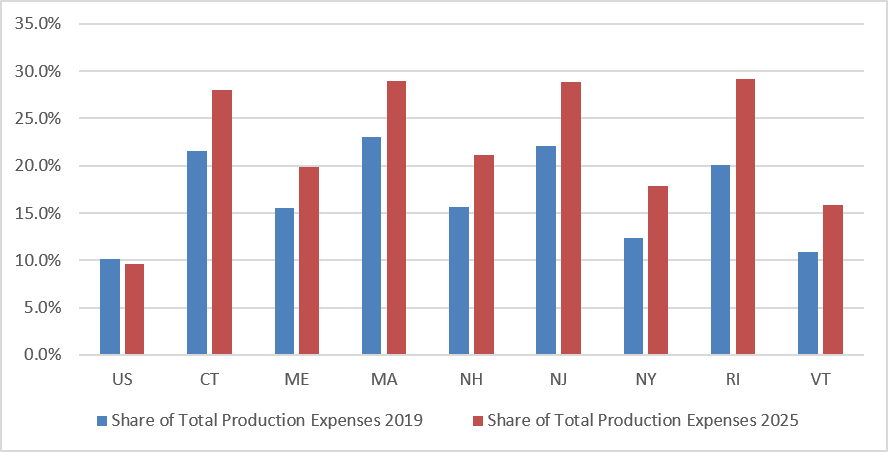
Data sourced from the USDA ERS Farm Income and Wealth Statistics: Production Expenses by Type, State Ranking table, 2017 and 2025.
Recent Changes to H-2A's AEWR
Effective October 2025, the Department of Labor (DOL) issued an interim final rule significantly changing how Adverse Effective Wage Rates (AEWRs) are calculated. AEWR is essentially the minimum wage for H-2A agricultural workers set high enough to ensure that employment of H-2A workers does not adversely affect the wages and working conditions of domestic workers. The October rule implements a new methodology using a skill and occupation-based structure; AEWRs are now calculated for two skill levels: Skill Level I (entry-level) and Skill Level II (experienced).
These changes lowered wage costs for H-2A employers in some states and for some occupations, leading to a legal challenge by the United Farm Workers (UFW) in November 2025. A court rejected UFW’s request for an injunction in May of this year (2026), maintaining DOL’s interim rule.
|
Table 1. Minimum and Average Agricultural Wages, Northeast |
|||
|
State |
AEWR for H-2A Workers Field and Livestock Worker (2026) |
State Minimum Wage (2026) |
|
|
Skill Level I |
Skill Level II |
||
|
Connecticut |
$14.18 |
$16.32 |
$16.94 |
|
Maine |
$13.13 |
$16.85 |
$15.10 |
|
Massachusetts |
$12.70 |
$15.10 |
$15.00 |
|
New Hampshire |
$11.69 |
$14.04 |
$7.25 |
|
New Jersey |
$14.10 |
$17.58 |
$15.92 (6+ employees) $14.23 (<6 employees) |
|
New York |
$13.62 |
$16.70 |
$16.00 (outside NYC, Long Island and Westchester) |
|
Rhode Island |
$13.14 |
$16.78 |
$16.00 |
|
Vermont |
$14.42 |
$17.82 |
$14.42 |
|
Average gross wage rates for field and livestock workers |
April 2025 |
||
|
Northeast I (CT, ME, MA, NH, NY, RI, VT) |
$18.66 |
$18.60 |
|
|
Northeast II (DE, MD, NJ, PA) |
$18.36 |
$17.68 |
|
The average national AEWR is $15.96 per hour, more than double the current domestic minimum wage of $7.25 per hour. The table also highlights the legal state minimum wage and average wage paid to agricultural workers for the Northeast, for comparison. Data sourced from the U.S. DOL’s Statewide 2026-2027 IFS AEWRs and the USDA NASS May 2025 Farm Labor Survey.
What Happens Now
Currently, SAWA has been introduced in the House of Representatives and has a growing number of co-sponsors. Labor issues fall under the jurisdiction of the House Judiciary Committee, where the bill awaits consideration from Chairman Jim Jordan (OH-4). While there are multiple paths for the bill to advance, there are only a few weeks left on the legislative schedule with a number of competing priorities, including the 2026 Farm Bill.
While the bill continues to move through Congress, agricultural organizations across the country are advocating for its passage. Farm Credit East has joined nearly 500 agricultural organizations in supporting the legislation by signing on to letters of support, citing the need for a workforce program that better meets the needs of today's agricultural employers.
As for AEWR, the future of the new methodology and the resulting rates is uncertain. Just weeks after the DOL released new AEWRs (on August 3, 2026), a federal court ordered the DOL to reformulate its methodology. The new rates remain in place for now, but the DOL published an alert that H-2A employers may need to make back wage adjustment payments sometime in the future, pending a judge’s decision when DOL releases the new wage methodology. For now, the August 3 rates stand.
Sources and Further Reading
Castillo, Marcelo; Simnitt, Skyler; Zahniser, Steven. Farm Labor. USDA ERA. 18 November 2025. https://www.ers.usda.gov/topics/farm-economy/farm-labor#size
Hause-Schultz, Rebecca; Schulte, Chris. Big Win for Agricultural Employers: Court Maintains DOL’s Game-Changer Rule for H-2A Farmworker Wages Despite UFW Challenge. Fisher Phillips. 18 May 2026. https://www.fisherphillips.com/en/insights/insights/court-maintains-dols-game-changer-rule-for-h-2a-farmworker-wages
Hause-Schultz, Rebecca; Schulte, Chris. DOL Issues Game-Changer Rule for H-2A Farmworker Wages: 8 Key Takeaways for Agricultural Employers. Fisher Phillips. 2 October, 2025. https://www.fisherphillips.com/en/insights/insights/dol-issues-game-changer-rule-for-h-2a-farmworker-wages
Hause-Schultz, Rebecca; Schulte, Chris; Viau, Joshua H. New H-2A Adverse Effect Wage Rates Up in Air as Court Orders DOL to Try Again: What Agricultural Employers Need to Know. Fisher Phillips. 27 August 2026. https://www.fisherphillips.com/en/insights/insights/new-h-2a-adverse-effect-wage-rates-up-in-air-as-court-orders-dol-to-try-again
OFLC Announces Updates to Implementation of the H-2A Adverse Effect Wage Rate Methodology for Non-range Occupations Interim Final Rule; Compliance with District Court Order. U.S. Department of Labor. 2 September 2026. Https://Flag.Dol.Gov/Announcement/2026-09-02
Smith, Lucas; Stup, Richard. H-2A Employer Back Pay Notice Circulated by USDOL. Cornell Agricultural Workforce Development. 4 September 2026. https://agworkforce.cals.cornell.edu/2026/09/04/h-2a-employer-back-pay-notice-circulated-by-usdol/
Editor: Chris Laughton
Contributors: Danielle Cummins, Legislative Affairs Officer and Kyle Karnuta, Knowledge Exchange Specialist
View previous editions of the KEP
Farm Credit East Disclaimer: The information provided in this communication/newsletter is not intended to be investment, tax, or legal advice and should not be relied upon by recipients for such purposes. Farm Credit East does not make any representation or warranty regarding the content, and disclaims any responsibility for the information, materials, third-party opinions, and data included in this report. In no event will Farm Credit East be liable for any decision made or actions taken by any person or persons relying on the information contained in this report.
Tags: labor, legislation
- Share this post on


