January 9, 2026
2026 U.S. Maple Syrup Outlook
Volume 20, Issue 1
January 2026
Contributed by Mark Cannella, Extension Associate Professor, University of Vermont
United States maple syrup production in 2025 stayed strong and within 2% of the 2024 crop, hovering just below 6 M gallons or ~ 66 M pounds. The national tap count is holding near 17 M taps and the average yield remained consistent at 0.34 gallons syrup per tap. Different regions across the country may have experienced a below average crop, as expected for this weather and site sensitive seasonal harvest. Despite regional variation, it is notable that overall syrup supply has been level for two consecutive years.
Vermont remains the leading production state in the country, serving up ~50-55% of domestically produced syrup. Syrup production is increasing in the majority of active states and the cumulative average growth rates (CAGR) is highest in Vermont, Maine and Wisconsin over the past 20 years. Wisconsin contributes an ever-increasing portion to the national crop with recent USDA National Agricultural Statistics Service crop reports demonstrating high rates of overall growth and the highest reported production yields of all U.S. states in both 2024 and 2025.
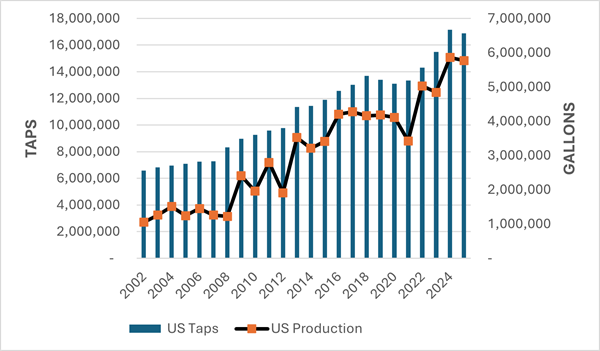
Figure 1: U.S. Maple Taps and Syrup Production 2002-2025 (Source: USDA NASS)
U.S bulk syrup producers, sellers and syrup processors faced serious downward price pressure due to high currency differentials between U.S. and Canadian dollars during winter 2024/25 and Spring 2025. The exchange ratio surged to $1 USD: $1.40-$1.45 CAD during 2025. Canadian syrup imports are needed to satisfy over half of overall U.S. syrup demand, and a strong U.S. dollar (or weakening Canadian dollar) gives Canadian imports a significant price advantage over domestic syrup. The major grocery and club store chains continue to be driven by price.
Economists at the University of Vermont are monitoring the national average prices received for maple syrup and have launched a public facing website to track these changes over time. The maple economy is not experienced the same for all businesses and market channel pricing provides the necessary detail to distinguish between different business models. Maple producers selling direct retail have gradually increased prices since 2020, showing that they have made adjustments through high inflation periods and those prices are sticking (Figure 2).
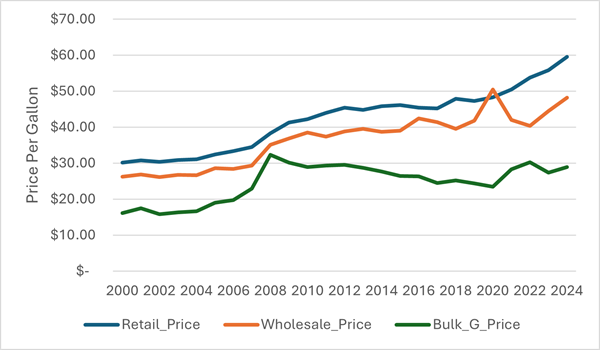
Figure 2: U.S. nominal maple syrup prices reported for three market channels
Bulk syrup sellers experienced periods of nominal price increases since 2020, but have also seen price declines which interrupt a consistent positive trend. Adjusting nominal prices (cash price at time of sale) for inflation adjusted real prices is a valuable analysis to understand trends over time. Figure 3 shows the real-inflation adjusted price trend for bulk syrup adjusted for inflation using the U.S. Bureau of Labor Statistics (BLS) Producer Price Index (PPI-base year 2005) to compare how market price received is adjusted to reflect a producers ability to pay for the inflating costs of production experienced across the agricultural sector. A similar figure can be produced for the retail and wholesale prices to show there has been a persistent nominal-real price differential that validates the cost-price squeeze reported by producers who say that gross sales received does not keep up with the increases in costs.
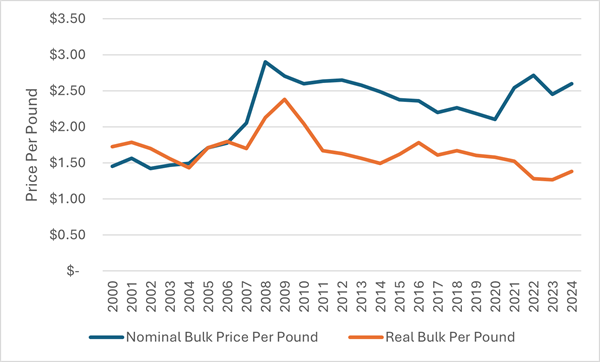
Figure 3: Nominal and real bulk syrup prices from 2000-2024
“Tell me something I don’t already know,” says every seasoned maple producer this information has been presented to! Many agricultural sectors have established an understanding of how economic conditions create a pattern of changes over a specified period of time. A cyclical pattern emerges for inflation-adjusted real maple syrup prices from 2000- 2024. When the twenty four-year period is divided into five-year increments (4 years for 2021-2024), there are alternating cycles of increases or decreases to the real price (Figure 4). While maple producers are constantly preparing for annual crop unpredictability, the cycle presented in Figure 4 suggests that overall market conditions play out over a more predictable multi-year cycle. No one factor can be singled out to explain this cycle, but the sum of economic forces may manifest in a series of positive years that will be counterbalanced by a flip to a series of poor price conditions.
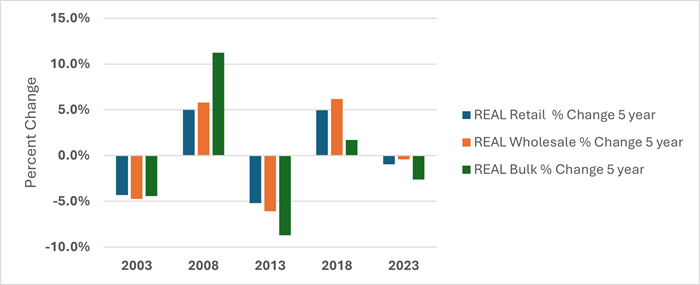
Figure 4: Five- year average annual percentage change for real prices 2000-2024 in three market channels
Tariffs
Tariff news dominated business conversations in 2025. Reports from syrup and supply company leaders in both the U.S. and Canada describe the situation as unpredictable and frustrating. Fluid syrup entering the U.S. is not currently subject to a tariff, but a complicated and evolving list of imported supplies and materials are having tariffs levied that has complicated final pricing. For manufacturers and distributors, the cost of goods ends up being inconsistent over longer periods of time which can lead to prior negotiations for business-to-business accounts to be unprofitable or profitable from order to order throughout the year.
Tariffs are keeping equipment prices high and will limit expansion and replacement of equipment for many producers. Some medium and small producers will face challenging decisions if they need to immediately replace a key piece of production equipment that is subject to tariffs.
Key Factors in Canada
Advanced pricing agreements in Quebec will result in a 1.6% increase on syrup prices paid to members of the Quebec Maple Syrup Producers (PPAQ) (See Table 1). The PPAQ has consistently been adding taps to the supply management quota over the past five years. Allocated tap expansions released in 2021 have been fully implemented and ~3.5 M - 4 M new taps are yet to be installed from the 2023 tap allocation. The newest 2025 tap allocation of 7 M new taps has been announced and will likely take 3-4 years until all taps are operational. Canada continues to demonstrate its capacity and interest to increase syrup production capacity and any strain on supplies and services will likely continue for the next few years as more new taps go in.
Table 1: Bulk Maple Prices and Market Factors
|
Year |
U.S. Bulk Prices3 (Average Across Table Grades) |
PPAQ Amber |
USD-CAD Exchange Rate |
Inventory Estimates |
|
2025 |
$2.30- $2.40 USD |
$3.33 CAD |
1.35
(High 1.44 Spring) |
Fall 2025: Quebec -Low Majority of Inventory is Organic Syrup |
|
2026 |
Announced after crop harvest May 2026 |
~$3.38 CAD (+ 1.6% negotiated increase) |
Estimated 1.35 with declining differential by late 2026 |
To be determined |
Consumer Trends and Market Growth
In 2025, University of Vermont (UVM) developed an anonymous maple seller research panel to capture information for the annual outlook. Information in the following section is descriptive, not statistical, and reflects input from sixteen panelists that include bulk syrup producers and sellers moving from ~300,000 lbs to over 5 M pounds of syrup annually.
Because maple syrup is sold in many ways and at many scales, there is no single trend that explains the entire consumer sentiment or behaviors for 2025 and 2026. Each maple seller is likely to observe different trends and is also likely to have different approaches based on their own needs and scale. Consumers in the U.S. are pulling back on discretionary spending largely due to inflation and increased living costs. At the same time, however, there is a growing population of consumers who are trying to make healthier and more natural food choices where practicable.
Maple sellers who sell direct to consumers in person and at smaller scales reported market growth of 8-10% in 2025. The positive growth for in-person sales is a good indicator but must be acknowledged to only represent a smaller volume of the overall national syrup supply. Businesses whose primary market channel is online shipping to consumers had mixed responses and said online market growth trended lower at 4-5% growth. These larger scale direct sellers (up to 1M pounds) anticipate flat prices in early 2026 with potential increases for those that can signal and deliver high quality features to the market.
Several panelists sell through regional business-to-business channels closer to their production or processing locations. Regional wholesale markets were positive but at the most modest rates observed across all channels, only 2-3%.
Our nation’s largest maple sellers continue to move an ever-increasing maple syrup crop through national distribution channels. This smaller group of maple sellers is estimated to sell well over 60-75+% of the domestic crop. Several panelists moving over 5 M pounds of syrup annually reported on market conditions in 2025 with consensus that markets expanded at rates in the higher single digits up to 10%.
Large volume national sellers expect continued market expansion but with the caveat of ongoing price pressures. The flow of competitively priced Canadian syrup is ever present and goals at the grocer level to diminish perceptions of food price inflation are likely to prevent sizable price increases and could impact volume if category shelf space shrinks.
Organic syrup demand is still strong, but large sellers share a concern that U.S. organic syrup supply could outpace consumer demand. Inflation could be a factor for consumers resulting in a slower growth rate for higher priced organic syrup. Organic pay price premiums have either been reduced by large bulk syrup buyers already or are being foreshadowed for 2026 to rebalance the organic syrup supply.
The major retail destinations for maple syrup nationally are increasingly pushing for quality control and supply chain compliance. Maple leaders see the emphasis on quality as a positive thing, but they also acknowledge the administrative burden for records and tracking requirements that is not expected to go away. Product integrity, quality enforcement and monitoring for adulteration was a notable concern from contributors for this outlook.
Concerns
Across all scales of production and sales there is a consistent concern about quality compliance, a perceived lack of enforcement and elevated concerns about product adulteration. The maple community points to the growth rate of the industry and remains concerned and perplexed that instances of demonstrably poor-quality syrup and an underinvestment in oversight persists. The Vermont Maple Sugarmakers Association (VMSMA) Sugarhouse Certification Program and access to testing at the new Maple Quality Laboratory at the University of Vermont stands out as positive steps, but community members agree that these efforts need to become more universally adopted to maintain the integrity of this high-quality sweetener nationwide.
Other notable concerns highlight the lack of an effective certified organic defoamer to be used as a processing aid. This concern aligns with a broader concern about the withdrawal of federal funding for research. A number of major objectives for the industry, like defoamer innovation or measuring environmental impacts, will be impaired if there is a longer-term reduction in resources for research.
Planning forward
Currency pressure may alleviate later in 2026 with strengthening fundamentals for the Canadian dollar. Major global banks see headwinds for the Canadian economy and expect high currency differentials to persist through the first two quarters of 2026. The Bank of Canada uses the CEER index as a trade-weighted proxy for the Canadian dollar and it remains at a nine year low as of late 2025. They anticipate a strengthening Canadian dollar in the later quarters of 2026. That could bode well for U.S sellers later in 2026 but it’s not clear if that outlook will be priced into the post-harvest price announcement expected in May or June 2026.
Moderating demand for organic syrup could be complicated by the anticipated outlook of U.S. producers. A survey of maple producers in Fall 2025 indicates that larger producers expect to expand production in the next three years. Sixty percent of producers with 10,000 taps or more expect to expand up to 20%, and roughly three quarters of that syrup is certified organic. Over 55% of operators with 5,000-9,999 taps express similar plans for expansion.
Producer sentiment is decidedly mixed moving into 2026. Maple producers are eternally optimistic moving from winter’s darkest days into the sap harvest, but the confluence of market pressures is real. High costs and flat prices will likely chill expansion hopes in 2026. Most producers will be happy to hold out or just hold on as politics and trade dynamics play out over the upcoming months.
1United States Department of Agriculture, National Agricultural Statistics Service: Crop Report, ISSN: 1936-3737. June 12, 2005. Available online at https://esmis.nal.usda.gov/sites/default/release-files/tm70mv177/m900qr657/rr173t99g/crop0625.pdf
2University of Vermont Maple Sustainability Indicators Website: https://www.uvm.edu/extension/ecomaple/ or Maple Economics at: https://www.uvm.edu/extension/ecomaple/topics/economics
3U.S. conventional prices posted in table. Organic premium payments are approximately +$0.15 - +$0.20 per pound
Editor: Chris Laughton
Contributors: Mark Cannella, Extension Associate Professor, University of Vermont
Mark Cannella is an Associate Professor and Farm Business Management Specialist with the University of Vermont Extension. He currently directs UVM Extension Agricultural Business programs with a focus on the management and delivery of farm and forest business planning programs, financial analysis and applied business research. Mark works directly on maple economics projects throughout the Northeastern United States and leads a national maple business education initiative. He works at the intersection of working lands business viability and stakeholder issues, developing research or training programs to support sustainable outcomes.
View previous editions of the KEP
Farm Credit East Disclaimer: The information provided in this communication/newsletter is not intended to be investment, tax, or legal advice and should not be relied upon by recipients for such purposes. Farm Credit East does not make any representation or warranty regarding the content, and disclaims any responsibility for the information, materials, third-party opinions, and data included in this report. In no event will Farm Credit East be liable for any decision made or actions taken by any person or persons relying on the information contained in this report.
2026 Maple Industry Outlook Webinar
On Tuesday, January 20, 2026, at 12:00 PM EST join Farm Credit East and Mark Cannella of the University of Vermont for a look at the Maple syrup and sugar industry in 2026.
Tags: outlook, economy, maple syrup production
- Share this post on


