March 3, 2026
2026 Oyster Industry Outlook
Volume 20, Issue 3.5
March 2026
Contributed by Bob Rheault, Executive Director of East Coast Shellfish Growers Association
Oyster farming in the U.S. has changed greatly from basic, old-fashioned methods to modern, intensive farming techniques. In the 1900s, oysters were seen as affordable staples, but today they are considered premium seafood served in upscale restaurants. Both wild and farmed oysters have important ecological roles and compete in the marketplace.
A Brief History
Native Americans consumed oysters in large quantities, as shown by massive shell heaps (middens). On arriving to the New World, colonists found oysters in abundance, and harvests grew alongside increasing populations and improvements in harvesting techniques. Peak harvests occurred in the 1800s, and coastal residents enjoyed oysters in great numbers. But by the late 1800s overharvesting and habitat loss caused by upland deforestation began to impact landings. Nevertheless, in the 1900s, New Yorkers consumed an estimated 500,000 bushels annually (about 660 per person). Biologists studying European culture methods learned that they could boost oyster populations by spreading shells in estuaries to catch early summer larvae. In the fall, early farmers would move the shells covered with juvenile oysters to privately leased bottoms for grow-out to market size.
Oysters are very sensitive to water pollution. The turn of the 20th century saw the invention of the flush toilet, but it took decades to improve wastewater treatment, and even today combined sewer outflows remain an issue during severe rain events. Oysters were commonly held in the contaminated waters of port cities, but the true causes of disease wasn't discovered until 1890. In 1900, oyster consumption was linked to a series of typhoid outbreaks and deaths, leading Congress to pass “Pure Food Laws” in 1906, which mandated a complete overhaul of processing and packing regulations. The media created a narrative connecting oysters to illness that caused demand to plummet, putting many large leaseholders in Connecticut and Rhode Island out of business. Regulations limiting harvests from polluted waters began to develop starting in 1940.
Modern Production
In the 1950s, researchers at the Milford Laboratory in Connecticut developed techniques for growing phytoplankton and spawning oysters in hatcheries. Several large hatcheries were soon established on Long Island, New York. During the 1950s, the emergence of the oyster diseases MSX and Dermo wiped out the harvests in the mid-Atlantic. As the use of hatcheries enabled selective breeding for desirable traits like disease resistance, over the next 50 years researchers developed disease-resistant lines by spawning survivors across many generations. This disease resistance allowed production in Virginia to rebound in 2015, restoring its dominance on the East Coast. In the late 1980s, the development of plastics led to the emergence of plastic mesh bags and vinyl-coated wire. The rapid expansion of hatchery-reared, intensive aquaculture quickly followed.
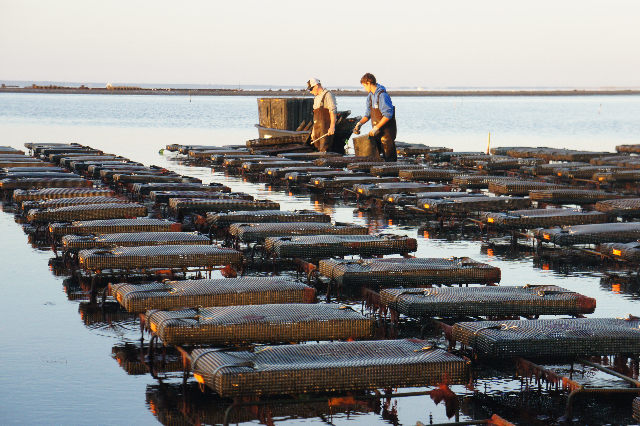
The Clean Water Act of 1972 and strict shellfish sanitation regulations ensured that consumers could enjoy raw shellfish with confidence, leading to a rapid increase in production to meet growing demand. Today, oysters originate from a variety of production methods. There is still a wild oyster fishery, although in New England it makes up only a small part of the total harvest. Connecticut growers continue to place tons of shells in the mouths of rivers each spring, where oyster larvae are likely to settle. Mountains of shells with attached juvenile oysters are then transferred to private leases for growout and dredge-harvest. This traditional method remains highly productive during years when natural set is strong. The majority of farmers in New England use plastic mesh bags held in cages that either sit on the bottom or float on the surface. Cages made of injection-molded plastic come in a variety of shapes. New designs of intensive growout gear arrive on the market each year.
Coastal pollution still limits where shellfish can be harvested. Although wastewater treatment continues to improve, expanding the areas where shellfish can be safely harvested, when large rain events occur wastewater treatment plants in major cities often become overwhelmed, leading to harvest closures. Most New England farms are located in salty waters, and the briny flavor allows New England oysters to command some of the highest prices in the country.
Today, oysters are farmed in every coastal state, with over 3,000 farms—primarily small-scale—that contribute significantly to the economies of many rural coastal communities. Oysters are recognized as important keystone species and ecosystem engineers that provide valuable ecosystem services, such as enhancing water quality and clarity, while providing superior habitat for juvenile fish. Oysters are also highly nutritious, being rich in protein, vitamin B, zinc and omega-3 fatty acids.
Once considered an inexpensive staple, oysters are now viewed as a celebratory food, often shared at parties and special events. They have become a premium seafood choice, featured on fine-dining menus and in raw bars. Several factors drive this market, including a growing consumer interest in gourmet cuisine. The rise of eco-tourism and experiential dining, exemplified by oyster-tasting events, festivals and farm-to-table trends, also boosts demand.
In the 1990s, oyster growers in New England began marketing branded, single oysters for raw bars, highlighting local differences in flavors and the distinctive qualities that various culture techniques and water bodies contributed to their product. Hatchery-reared oysters enabled growers to offer a uniform, consistent product. By 2010, hundreds of brands were being marketed like fine wines across the country.
U.S. oyster aquaculture has seen considerable growth over the past 20 years, driven by increased demand for half-shell oysters, advancements in technology, breeding programs, extension training and regulatory reforms. Traditionally, oyster consumption mainly occurred during the colder months with an “R,” when the meats are plump. The advent of triploid oysters—which are sterile due to an extra set of chromosomes—allows hatchery-reared oysters with full meats to be produced throughout the year.
An efficient, refrigerated-trucking network allows distributors to quickly and safely ship oysters nationwide within a day or two. The growth of refrigerated trucking and triploid oysters made high-quality farmed oysters available year-round. Raw bars that previously couldn't sell oysters in the summer suddenly had access to consistent, high-quality oysters throughout the year. Restaurants began adding raw bars to attract customers, sparking a resurgence in oyster consumption. By 2000, a popular restaurant guide listed over 900 raw bars in Manhattan alone.
Farmed production on the East Coast now greatly eclipses wild harvest, with 29,845 tonnes of live weight in 2023 and the highest farm-gate sales at $152 million (including seed sales).
New England
Since the development of intensive aquaculture techniques, the Northeast has experienced rapid growth in production. Wild harvests account for a small share of total production, although good wild sets are still frequently observed in Long Island Sound and some locations on Cape Cod.
Northern New England has historically had poor natural sets and today most of its production comes from intensive aquaculture of hatchery-produced seed. Growout takes place in bottom cages, trays or increasingly in floating cages. Massachusetts currently leads all New England states in oyster aquaculture, with about 300 growers harvesting nearly $30 million worth of farmed oysters. Maine's production has been growing rapidly, with 97 leaseholders harvesting $11.4 million worth. Rhode Island has 41 leaseholders, harvesting $7.5 million. New York has 84 farms producing around $4.4 million, while New Hampshire has just 16 farms harvesting approximately $650,000.
Overall, New England has around 580 leaseholders producing approximately 114 million oysters annually, valued at about $68 million (Figure 4). Growers in the region enjoy some of the highest prices, with an average farm gate price of roughly 60 cents. Additionally, New England has about 16 privately operated hatcheries of varying production scales.
Many states also are investing in oyster restoration projects to restore wild reefs, mainly for ecosystem services but, in some cases, to boost wild-harvest fisheries. The Nature Conservancy estimates that for every two acres of oyster reefs (or farms), the increased survival of juvenile fish that hide among the nooks and crannies can boost future fisheries landings by one to five tons annually. NOAA has documented how farmed oysters remove large amounts of excess nutrients from sensitive coastal waters, helping to mitigate eutrophication and reduce coastal hypoxia.
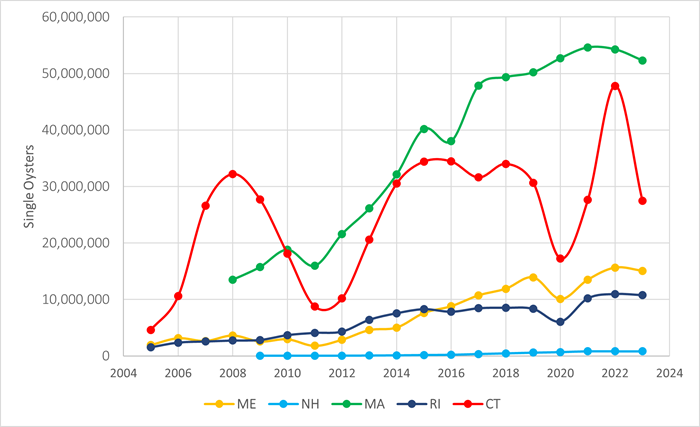
Figure 4. New England Oyster Aquaculture Production.
Industry growth in New England was dramatic from 1990 to about 2015, but growth appears to have slowed in recent years. Although lease acquisition is getting harder, farmers continue to increase production on existing leases. Growers are complaining that they are no longer able to raise prices, while input costs have shot up. There have been some tendencies toward consolidation as smaller farms succumb to economic pressures related to economies of scale.
The industry in New England is dominated by small growers, with production often restricted by the difficulties of securing large leases. This prevents most growers from gaining significant economies of scale that benefit larger companies.
New England production still lags behind that of major-producing states like Louisiana, which harvests between 250 million and 500 million oysters each year. Gulf production largely depends on wild oyster sets, supporting traditional methods similar to Connecticut's. Virginia leads all East Coast states with about 80 million oysters harvested, while the combined total for the five coastal New England states is approximately 120 million. This is comparable to the West Coast's total, where the primary species is the Japanese oyster, Crassostrea gigas.
In New England the wild harvest is small compared to farmed production, though there are pockets where good wild sets can be expected.
Challenges and Opportunities
There continues to be rapid development of new growout methods and equipment types, and government-funded breeding efforts aim to create regionally adapted lines of oysters that resist various oyster pathogens. Since labor often represents the biggest cost for most farms, there is a strong push to develop labor-saving tools such as computer-aided sorting machines and other devices to reduce some of the backbreaking work involved.
A rapid increase in oyster imports from Atlantic Canada has significantly impacted demand for New England growers. Since 2020, Canada has tripled its exports to the US to $60 million. This past year, they experienced a major outbreak of the oyster parasite MSX, suffering 80 -90% losses. We expect resource managers will permit growers to import resistant lines from U.S. hatcheries, which should help the industry recover in about three years. Until then, U.S. growers should see a welcome recovery in demand.
Over the past few years, shellfish farmers have gained access to the Emergency Livestock Assistance Program (ELAP) crop insurance through the Farm Service Agency. This program covers similar weather-related hazards as the FSA Non-Insured Crop Disaster Assistance Program (NAP), but it is free and offers a better payout ratio. The USDA’s Risk Management Agency (RMA) is also introducing a commercial crop insurance option. These programs help reduce much of the risk associated with crop loss due to storm damage, but there are still no insurance options available to cover gear losses.
As production in many coastal areas has increased to exceed local demand, there is a strong motivation to sell products in inland cities to avoid local price competition. Throughout much of the 1990s and until around 2015, growers saw great opportunities to expand production. The COVID-19 pandemic revealed that over 90% of oysters were sold in restaurants; sales plummeted during the lockdown. The resulting inflationary pressures have raised costs for gear, labor, and shipping, but growers have noticed resistance from dealers to increase farm-gate prices.
At the same time, inflation has significantly raised costs for restaurants. As a result, they have sharply increased prices on oysters, so diners now see single oysters costing $4 or even $6, which decreases demand. Economic pressures are pushing many diners to choose fast casual or takeout instead of fine dining. Those who still dine at upscale places are often skipping appetizers and desserts. All of these trends are hurting sales.
As production continues to grow, many are beginning to see falling prices at the farm gate. The push to reduce costs and automate will soon pressure farmers to consolidate in order to improve economies of scale. Small growers face shrinking profit margins, and the bottom line for these smaller operations makes what was once a profitable job more uncertain. Future growth will depend on automation to reduce costs and increase efficiency, combined with aggressive marketing to boost demand. Since most Americans are reluctant to shuck their own oysters, there is an opportunity for ready-to-eat, value-added products that consumers can buy in the frozen food aisle and take home to heat up.
Editor: Chris Laughton
Contributors: Bob Rheault, Executive Director of East Coast Shellfish Growers Association
View previous editions of the KEP
Farm Credit East Disclaimer: The information provided in this communication/newsletter is not intended to be investment, tax, or legal advice and should not be relied upon by recipients for such purposes. Farm Credit East does not make any representation or warranty regarding the content, and disclaims any responsibility for the information, materials, third-party opinions, and data included in this report. In no event will Farm Credit East be liable for any decision made or actions taken by any person or persons relying on the information contained in this report.
2026 Oyster Industry Outlook Webinar
Tuesday, March 3, 2026
12:00 PM - 1:00 PM EST
Farm Credit East and Horizon Farm Credit hosted Bob Rheault of East Coast Shellfish Growers Association for an outlook on oyster farming approaches, challenges and markets.
Tags: ag economy, outlook, aquatic, commercial fishing
- Share this post on


