March 3, 2026
Forest Products Industry Outlook: Softwood Markets Set to Stabilize in 2026
Volume 20, Issue 3
March 2026
Contributed by Paul Jannke, Forest Economic Advisors, LLC
North American lumber markets saw another weak year in 2025, with consumption estimated to have declined by 2.1% for the year. In 2026, growth in housing starts is projected to be offset by declines in residential-improvement expenditures, resulting in a mere 0.4% increase in consumption. By 2027, however, a recovering U.S. economy and strengthening end-use markets are forecast to drive a more robust 2.8% increase in North American lumber consumption.
Lumber capacity declined 1% in 2025, despite the massive post-COVID-19 investment in the U.S. South. Closures in the second half of 2026, combined with tight margins (especially across Canada, where mills are faced with combined duty and tariff rates of just over 45%), will lead to further capacity declines in 2026 despite our forecasted improvement in consumption. With demand growth accelerating in 2027, we expect capacity to stabilize for the year.
Production declined 2% in 2025 as weak markets forced extensive mill curtailments in addition to permanent closures. We expect production to increase 2% in 2026. While we expect a slight improvement in consumption, this growth will be predominantly driven by growth in net exports as exports increase while imports decline. Accelerating consumption growth, combined with a continued decline in imports, will drive production more than 3% higher in 2027.
While operating rates will be only slightly higher in 2026, we expect lumber prices will continue to improve for the year. Increased prices will be driven by the supply side and not growing consumption. High duties and tariffs will limit Canadian lumber shipments to the U.S. Furthermore, we expect additional curtailments and closures as consumption remains weak. These factors will push prices higher in 2026. While we expect the duties will fall in 2027, rising demand on North American mills will push prices still higher in 2027.
Housing Demand
Residential construction, made up of new construction and additions and alternations to existing stock, accounts for 70–75% of lumber consumed in the U.S. Housing starts are the measure of new construction; residential-improvement expenditures measure activity in additions and alterations.
Housing starts declined 4.0% in 2024 and a further 2.3% in 2025 as steep borrowing rates and high inflation put home purchasing out of reach for many potential buyers. These factors also discouraged homeowners from placing their houses on the market, creating low inventories of existing homes for sale.
We expect housing starts to grow a modest 1.5% to 1.36 million in 2026 before growth accelerates to 5.6% in 2027, pushing starts to 1.43 million units (Chart 1).
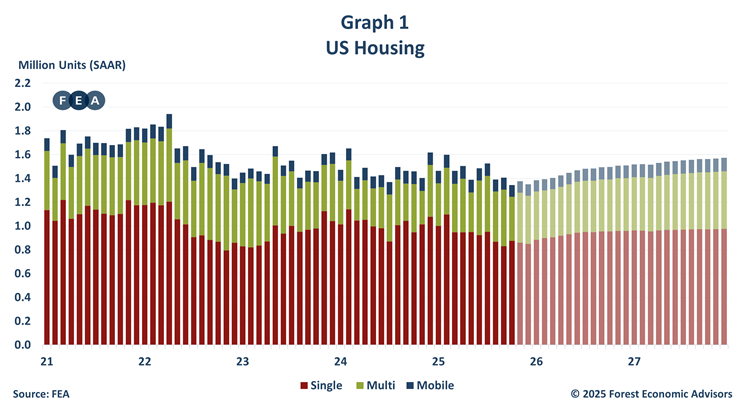
There are several reasons for this gradual improvement. Home prices and mortgage rates have begun to fall, and we expect this decline to continue. Meanwhile, the U.S. economy should continue to grow despite trade and labor-force headwinds. Starts will be bolstered by strong fundamentals such as extremely high pent-up demand and demographic tailwinds due to the large population of the millennial generation that are now at the age when many are ready to buy their first home. Additionally, the inventories of homes for sale are historically low. This means the number of homes that need to be built will exceed pre-pandemic levels.
Supply-side constraints will partially offset improving affordability conditions and strong fundamental demand. Homebuilders face severe cost increases—regulatory, land, labor and financing—that they cannot pass on to affordability-strapped buyers. This dynamic forces builders to offer significant price cuts and incentives, eroding profit margins and creating a powerful disincentive to initiate new projects. A critical structural labor shortage compounds this issue by limiting the industry’s physical capacity to expand production.
Residential-improvement expenditures declined by an average of 7% year-over-year during the May–October period—the most recent six months of available data. Continued weakness in the apparent consumption of lumber and panels, alongside cautious guidance from big-box retailers, suggests this contraction persisted through December. Consequently, we expect expenditures to fall by 5% in 2025.
We forecast that residential-improvement expenditures will fall an additional 2% in 2026. Persistent affordability concerns stemming from high interest rates and weak income growth, as well as structural headwinds, drive this decline. Factors such as declining remodeling permits, persistent labor shortages and the expiration of energy-efficiency tax incentives will likely hamper demand. Finally, we expect residential-improvement expenditures will increase 3% in 2027. This growth will occur as affordability and homeowner confidence improve while homeowners continue to fix up rather than move up.
Softwood Lumber Demand and Prices
While we expect 2026 to mark the beginning of a turnaround for softwood lumber demand and prices, not all end-use markets will improve at the same pace. Modest growth in housing starts will be partly offset by continued declines in residential-improvement expenditures. Consequently, U.S. lumber consumption will grow by just 0.2% overall. By 2027, however, a recovering U.S. economy and strengthening end-use markets are forecast to drive a more robust 2.4% increase in consumption. Total North American consumption (Canada + U.S.) will grow by 0.7% to 59.9 BBF in 2026 and by 2.7% to 61.5 BBF in 2027.
Offshore imports remain constrained by weak demand, pricing pressures and rising European production costs tied to higher timber prices. However, offshore exports are forecast to increase in 2026. Much of this increase will come from Canadian mills, which have been finding alternative markets for their lumber in the wake of high U.S. tariffs. U.S. southern yellow pine exports are also forecast to rise slightly.
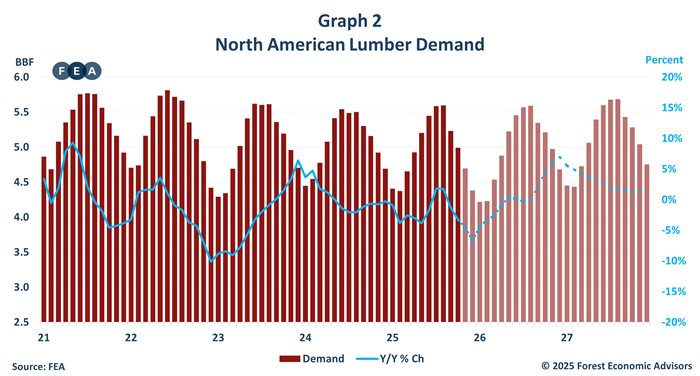
Putting it all together, demand on North American mills (calculated as consumption plus exports minus imports) is expected to grow by 2.0% in 2026, followed by an average annual increase of 3.0% in 2027 (Chart 2).
Lumber prices, as measured by the Framing Lumber Composite Index (FLCI), increased by 9.8% in 2025, driven mainly by increasing duties and tariffs, but also by mills’ increased willingness to close as prices dropped below costs (Chart 3). There were significant regional differences. Spruce-pine-fir (SPF) prices jumped 14% in 2025 as mill closures and rising duties drove SPF prices higher. Meanwhile, Western U.S. lumber prices moved up a more moderate 4–10%, driven higher by rising demand for alternatives to Canadian-produced SPF. Finally, rapid capacity expansion in the U.S. South, combined with resistance on the part of some builders to substitute southern yellow pine for SPF, resulted in just a 4% increase for westside southern yellow pine prices.
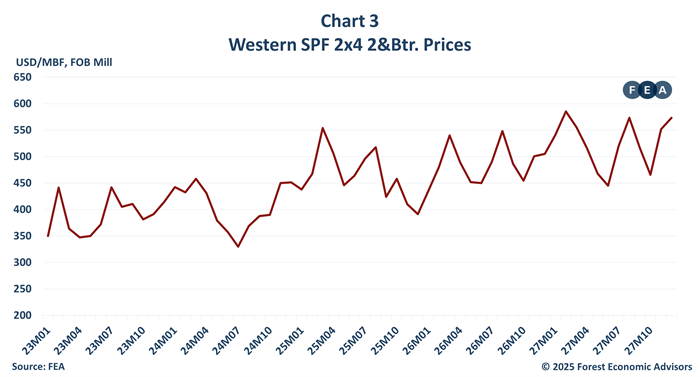
We expect prices will rise another 3.1% in 2026 as economic growth and end-use market activity begin to recover, and 7.7% in 2027. By the latter year, demand growth will begin to outstrip supply growth, resulting in the accelerated price increase.
While strong, this price increase is more moderate than we typically see when markets are recovering. We anticipate this moderation because countervailing (CVD) and antidumping (ADD) duties are expected to fall by approximately 10% in August 2026 and remain at that lower level through 2027. This reduction in duties will decrease the cost of Canadian lumber, offsetting some of the upward price pressure from strong market fundamentals.
Trade uncertainty, weak demand, low dealer inventory levels and low mill production will likely contribute to market volatility throughout the forecast period.
Pulp Outlook
2025 marked another difficult year for the U.S. pulp and paper industry. Paper and packaging end-use markets softened alongside weaker economic growth. This, combined with limited opportunities in international trade markets, pushed total U.S. paper and paperboard production down an estimated 3%.
Looking ahead, the outlook for pulp and paper end-use markets remains mixed. Paper consumption is expected to remain weak, averaging 20.4 million tons—approximately 10% below the average of the past five years. In contrast, the demand outlook for paper packaging is more positive. Substitution of paper packaging for plastic, along with the continued growth of e-commerce, is expected to support rising demand in the coming years. As a result, U.S. paperboard and packaging consumption is projected to reach 48.4 million tons by 2029. This would represent a 10% increase relative to 2025 and would exceed the previous peak reached in 2021 by about 1%.
In addition to weak consumption, pulp mills across the U.S. faced intense competition from offshore producers. Significant investment in new large-scale, efficient pulp capacity in the Southern Hemisphere—based on wood fiber from short-rotation, high-yield hardwood plantations—is reshaping the competitive landscape and accelerating the closure of older, higher-cost mills. In the U.S., pulp mill closures have been concentrated in the South, where five shutdowns were announced in 2025 alone. In the Northeast, no permanent closures have been announced recently, though weak market conditions and fiber-supply challenges led to a monthlong idling of the Woodland pulp mill in late 2025.
U.S. pulp production in 2025 is estimated at 39.4 million tons, roughly 19% below 2021 levels. Recovery in U.S. pulp production is expected to be modest, with total output projected to edge higher to just above 42 million tons by the end of the decade. Given the risk of additional mill closures, downside risk to this outlook remains.
In the Northeast, pulpwood demand is expected to improve modestly over the next five years. Stronger end-use markets should translate into slightly higher operating rates and support incremental increases in wood-fiber demand. The ramp-up of Sappi’s recently converted and expanded paperboard line at its Somerset Mill will also bolster pulpwood demand. Even so, pulpwood demand is expected to remain well below levels sustained during the late 2010s through the end of the decade.
Improving demand should support modest increases in pulpwood pricing, particularly on a delivered basis. Contraction in the region’s logging and trucking sectors has pushed harvest and delivery costs higher and will likely need to remain elevated to maintain an operational supply chain. In contrast, increases in pulpwood stumpage prices are expected to be more limited.
Editor: Chris Laughton
Contributors: Paul Jannke, Forest Economic Advisors, LLC
View previous editions of the KEP
Farm Credit East Disclaimer: The information provided in this communication/newsletter is not intended to be investment, tax, or legal advice and should not be relied upon by recipients for such purposes. Farm Credit East does not make any representation or warranty regarding the content, and disclaims any responsibility for the information, materials, third-party opinions, and data included in this report. In no event will Farm Credit East be liable for any decision made or actions taken by any person or persons relying on the information contained in this report.
2026 Forest Products Industry Outlook Webinar
Tuesday, March 17, 2026
12:00 PM - 1:00 PM EST
Join Farm Credit East, Horizon Farm Credit and Presenter Paul Jannke of Forest Economic Advisors for insights on the 2026 forest products industry.
Tags: outlook, economy, forestry, lumber, logging, report, timber
- Share this post on


