September 8, 2026
Navigating a Changing Cattle Market
By Megan Clancy, Dairy & Livestock Risk Management Senior Advisor and Kyle Karnuta, Knowledge Exchange Specialist
National cattle policy grabbed headlines in August as the market continues to defy principles of economics: beef prices at the grocery store continue to soar while the size of the national cattle herd struggles to keep up. This blog dives into the factors driving these market conditions and the steps producers can take in response.
Cattle Market Snapshot
Consumers buying beef at the grocery store are seeing record prices, with ground beef nearing $7 per pound, up $0.63 per pound since July 2025, and sirloin steaks nearly $15 per pound, up $1.04 since July 2025.1 While beef prices have been rising steadily since 2021 (Figure 1), consumer demand has remained strong. Earlier this year, Beef Checkoff published a report showing beef sale volume up 4.3% in 2025 vs 2024, remaining near record high per capita consumption despite some growing price sensitivity among consumers. Nearly ¾ of American consumers report eating beef weekly and over 1/3 rank beef as their top protein choice.
Figure 1: Average ground beef prices August 2010 – July 2026
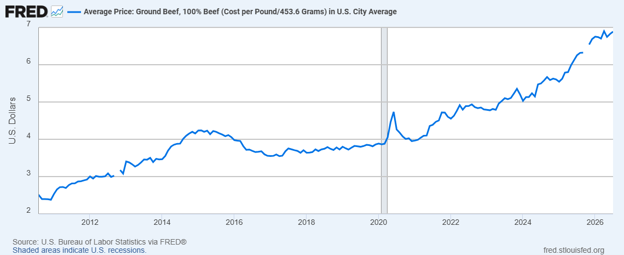
Source: U.S. Bureau of Labor Statistics via Federal Reserve Bank of St. Louis
Yet, while consumer prices and demand continue to rise, the U.S. cattle herd is shrinking, with the July 2026 calf crop down approximately 500,000 head year-over-year. This herd is the smallest since the 1950s. July placements in feed lots were down 11% vs July 2025, partially a result of ranchers moving animals off forage and into feed lots earlier in the year due to drought.2 Drought continues to be a persistent driver of challenges and costs for ranchers and a contributor to high costs both at the farm gate and beyond.
These historically low cattle herd figures are at the root of high consumer prices – so why aren't we seeing more growth to the herd?
Factors contributing to herd decline
Multiple factors contribute to this sustained decline, from record high beef imports to higher input and operational costs (which reached a record high of $1,762 per head in 2025, +30% vs 2020) felt by ranchers (Figure 2). Increasing dependence on beef imports, which raises retail margins but depresses wholesale packer margins, and a shrinking domestic herd have been cited as justification for the closure of major beef processing facilities across the country.3 Fewer processors mean higher transportation expenses for ranchers, further straining their margins and possibly leading to further herd reduction.
Figure 2: Cow-calf production costs 1996 – 2025
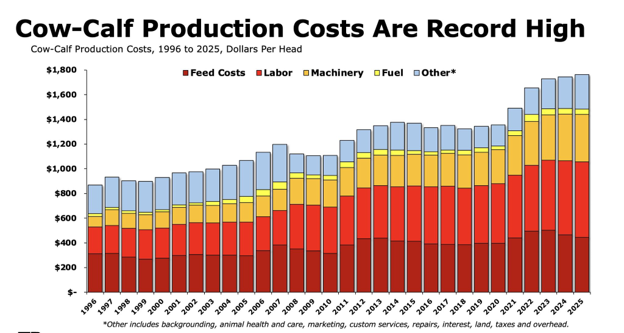
Source: USDA ERS, analysis by American Farm Bureau Federation
Tariffs & Increasing Beef Imports
We expect to see beef import figures continue to rise in the near future (Figure 3). Border ports closed to cattle trade from Mexico since 2024 in response to the spread of the New World screwworm pest, are expected to reopen this fall, with the first re-opening in Arizona on August 24. The Associated Press reports that imports will gradually increase from 700 to 1,300 cattle per day from this location, and more border openings could soon follow.
Meanwhile, on August 26, President Trump signed a proclamation removing tariffs from 300,000 metric tons of imported lean beef trimmings, used to make ground beef, for 90 days. The move has sparked considerable industry backlash from organizations, including the American Farm Bureau Federation, Livestock Marketing Association and the National Cattlemen's Beef Association.
Figure 3: U.S. beef imports 2000 – 2025, including 2026 projection
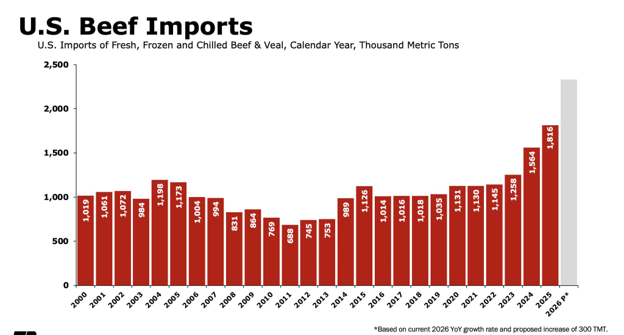
Source: USDA ERS, analysis by American Farm Bureau Federation
“While President Trump’s intent to remove tariffs on imported beef might temporarily lower grocery prices, it will have a crushing effect on our already fragile domestic beef market,” New York Farm Bureau President David Fisher said in an August 24 statement. “This tariff removal, combined with recent cuts on beef prices paid to farmers and record-level beef imports, will only make a volatile market worse.”4
In response, President Trump signed executive orders on September 4 to support the domestic cattle industry. The orders include directives for the USDA to ease regulations to allow ranchers the flexibility to sell their products directly to consumers, to explore country-of-origin labeling, and a host of other provisions. Many of these changes would still require regulatory changes or congressional action. Federal legislators have already proposed bills, including the PRIME Act (allowing custom processors to sell meat directly to consumers) and the RANCH Act (restoring grazing land for ranchers). The Department of Justice has also announced ongoing antitrust investigations into major grocery chains over high beef retail prices.
Beef-on-dairy
Cattle markets significantly impact dairy operations. Beef-on-dairy has grown from an experimental trend to a significant strategy for dairy revenue diversification, with beef-on-dairy calves selling for up to $1,500 per head at some auctions in 2025, up from $600-$800 just a year before,5 and beef-on-dairy cattle now represent 12%-15% of all fed slaughter.6 While questions remain about the real impact of beef-on-dairy on total beef production, it is clear that beef cattle markets directly impact both cattle ranchers and dairy farmers.
Protecting the Opportunity: Livestock Risk Protection
Cattle and dairy producers experienced a clear example of this risk over the summer when live and feeder cattle futures fell sharply in July, pulling feeder and fed cattle markets lower. Markets began to recover in August, but volatility remained elevated.
No one knows exactly where cattle prices will be three, six or twelve months from now. Current fundamentals suggest cattle supplies will remain tight, and that could continue to support historically strong prices. But the market correction experienced this summer demonstrates how quickly sentiment and prices can change.
Risk management does not necessarily mean believing the cattle market is headed lower. It means recognizing that today’s price levels have value and deciding how much downside risk an operation is willing and financially able to carry. Livestock Risk Protection (LRP) is a USDA Risk Management Agency program designed to protect livestock (and dairy) producers against declines in market prices.
For cattle producers, protecting a portion of expected sales with LRP can provide greater certainty around future revenue while preserving the opportunity to benefit if cash cattle prices continue higher.
For dairy producers, the same conversation should extend beyond milk. As calf and cull cow values have become increasingly meaningful contributors to farm income, protecting livestock revenue can become another component of the farm’s overall risk management strategy.
On August 31, the USDA announced its expanding LRP with the new Beef Retention and National Development (BRAND) endorsement to support heifer retention. The endorsement allows producers to protect the economic value of retaining heifers for breeding over a two-year period, helping reduce the financial risk of long-term herd expansion and replacement decisions.
Today’s cattle market continues to offer tremendous opportunity, but opportunity and risk often go hand in hand. Producers with cattle to market in the coming months should consider reviewing current LRP coverage opportunities with a Farm Credit East Dairy & Livestock agent to determine whether establishing a price floor makes sense for their operation. In a market capable of moving as quickly as this one has, having a risk management plan in place before the next major move can make a meaningful difference.
1Sitz, Alicia; Haeberle, Bennett. "Farmers Oppose Trump's Plan to Import Beef. Here's Why." August 24, 2026. News Nation Now. https://www.newsnationnow.com/business/your-money/farmers-oppose-trump-importing-beef-prices/
2Stump Denton, Angie; Rook, Michelle. " Bullish Cattle on Feed Report Clashes with Plant Closures, Policy Fears." August 21, 2026. Drovers. https://www.drovers.com/news/bullish-cattle-feed-report-clashes-plant-closures-policy-fears
3Bullard, Bill. "Op-Ed: Domestic Beef Supply Chain on Road to Ruin." August 20, 2026. Morning Ag Clips. https://www.morningagclips.com/op-ed-domestic-beef-supply-chain-on-road-to-ruin/
4"NYFB on President Trump’s Announcement to Pause Tariffs on Imported Beef." August 24, 2026. Morning Ag Clips. https://www.morningagclips.com/nyfb-on-president-trumps-announcement-to-pause-tariffs-on-imported-beef/
5Eadie, Tanya. "New Price Signals Reshape Dairy Farms' Decisions, by: Corey Geiger." October 16, 2025. https://dairyproducer.com/beef-on-dairy-revenue-growth-2025/
6"Inside the 2025 Beef-on-Dairy Industry Report: Quality Over Quantity." November 15, 2025. Farm Progress. https://www.beefmagazine.com/livestock-management/inside-the-2025-beef-on-dairy-report-quality-over-quantity
- Share this post on


